
Futsal ball and soccer ball differ in size, bounce, design, and use. Learn which ball is right for indoor futsal or outdoor soccer.
If you are new to futsal or looking for the right ball for training, you may wonder what is the difference between futsal ball and soccer ball. Although both balls are designed for football-based sports, they are made for different playing environments and have different performance characteristics.
A futsal ball is specifically designed for indoor courts and smaller playing areas, while a standard soccer ball is primarily designed for outdoor football played on grass or artificial turf. The biggest differences include size, bounce, construction, playing surface, weight, and ball behavior.
Understanding these differences can help players, coaches, clubs, academies, and sports businesses choose the right ball for their needs.
What Is a Futsal Ball?
A futsal ball is a specialized ball designed for the fast-paced indoor game of futsal. Futsal is normally played on a hard indoor court with five players per team, creating a game that depends heavily on close control, quick passing, accurate shooting, and fast decision-making.
FIFA describes futsal as being played with a ball that is optimized to bounce less than a conventional football. This lower-bounce characteristic is important because it keeps the ball closer to the playing surface and makes it easier for players to control during rapid indoor play.
Because there is less space on a futsal court, players need a ball that responds predictably to passes, touches, and shots. This is why a professional futsal ball, training futsal ball, or FIFA-quality futsal ball has characteristics that differ from a regular outdoor soccer ball.
What Is a Soccer Ball?
A soccer ball is designed for traditional football played on a larger outdoor field. Standard adult soccer generally uses a size 5 soccer ball, although smaller sizes are used for youth players.
A conventional soccer ball is designed to travel longer distances and perform well on grass or artificial turf. Its bounce and flight characteristics are different from those of a futsal ball because the playing environment is different.
According to FIFA’s football standards, footballs are tested for factors including weight, circumference, roundness, bounce, water absorption, pressure loss, and shape and size retention.
This means ball performance is not simply about appearance. Construction and testing can have a major effect on how a ball behaves during a match.
Futsal ball and soccer ball
A futsal ball and soccer ball are designed for different playing environments and styles. A futsal ball is made for indoor courts, with a smaller size and lower bounce that helps players maintain close control and make quick passes.
A soccer ball is usually larger and designed for outdoor fields, providing better flight and bounce for long passes and aerial play. Choosing the right ball depends on the playing surface, game type, player level, and training needs.
Futsal Ball and Soccer Ball Key Differences
| Feature | Futsal Ball | Soccer Ball |
|---|---|---|
| Main use | Indoor futsal | Outdoor soccer/football |
| Typical size | Smaller than standard soccer ball | Usually size 5 for adults |
| Bounce | Lower bounce | Higher bounce |
| Playing surface | Indoor hard court | Grass or artificial turf |
| Ball control | Designed for close control | Designed for distance and varied play |
| Game environment | Small, fast indoor court | Large outdoor field |
| Common use | Futsal training and matches | Soccer training and matches |
| Construction | Often designed for controlled indoor response | Designed for outdoor durability and flight |
These futsal ball and soccer ball differences explain why using the correct ball can make a noticeable difference during training and competition.
1. Size Difference
One of the first differences players notice is the size.
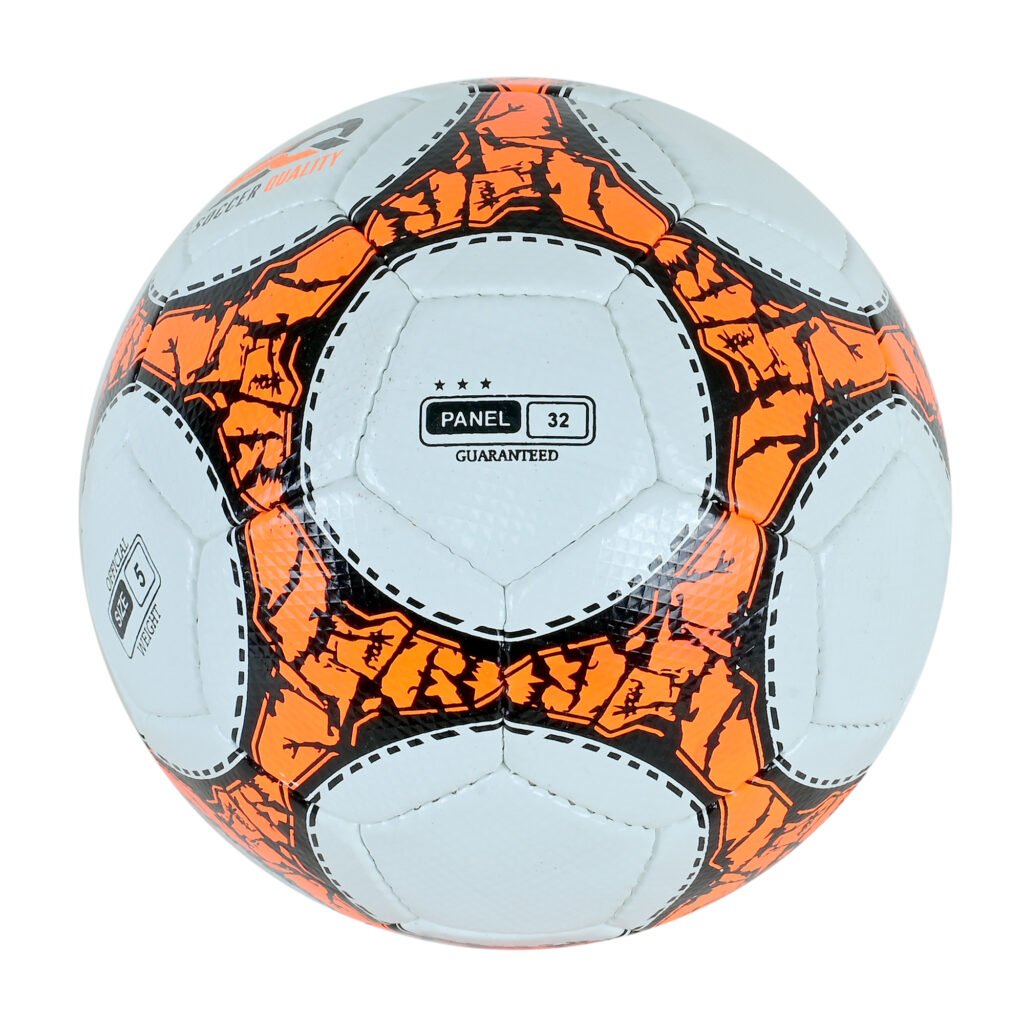
A standard adult soccer ball is generally a size 5 ball, with a circumference of approximately 68–70 cm. FIFA’s Laws of the Game specify a circumference between 68 and 70 cm and a starting weight between 410 and 450 g for standard football match balls.
Futsal balls are generally smaller in circumference and are designed specifically for indoor play. Their reduced size makes them easier to manage in tight spaces.
The smaller profile of a futsal ball supports close control, quick passing, and technical play. For this reason, clubs and academies should avoid assuming that a standard soccer ball is automatically suitable for futsal training.
2. Bounce Is a Major Difference
The bounce is one of the most important differences between a futsal ball and soccer ball.
A standard soccer ball is designed to bounce effectively on grass or artificial turf. This allows players to make aerial passes, control long balls, and play across a much larger field.
A futsal ball is designed with a reduced-bounce construction. FIFA specifically describes futsal as using a ball that bounces less than a traditional football.
Lower bounce helps keep the ball closer to the floor. This is especially useful in futsal because the game is played in a smaller space where fast passing and ball control are essential.
For technical training, a low-bounce futsal ball can also encourage players to improve first touch, passing accuracy, dribbling, and close control.
3. Playing Surface
The playing surface is another major factor.
Soccer is commonly played outdoors on natural grass or artificial turf. A soccer ball must therefore be capable of handling larger spaces, longer passes, different weather conditions, and varied playing surfaces.
Futsal is normally played indoors on a hard court. FIFA has dedicated quality standards and testing programs for different football formats, including futsal balls.
Because the surface is harder and the playing area is smaller, a futsal ball needs to provide predictable movement and controlled bounce.
4. Ball Control and Passing
Futsal is known for close-range technical play. Players frequently receive and pass the ball within a short distance.
A low-bounce futsal ball helps players keep the ball under control. It is well suited for:
- Short passing
- Quick combinations
- Close dribbling
- First-touch training
- Ball retention
- Fast shooting
- Technical skill development
A soccer ball, in comparison, is designed for a much larger playing environment. Players regularly use longer passes, crosses, through balls, and aerial play.
This does not mean one ball is better than the other. They are simply designed for different forms of the game.
5. Weight and Construction
Ball construction can also vary between futsal and soccer balls.
A quality soccer ball may use materials such as PU or TPU, multiple backing layers, specialized bladder systems, and machine-stitched, hand-stitched, or hybrid construction.
Futsal balls can also use high-quality PU or similar outer materials, but their internal construction is designed around the specific performance requirements of indoor futsal.
For buyers looking for custom futsal balls, construction is especially important. Clubs, academies, distributors, and sports brands may need specific requirements for the outer casing, bladder, panels, stitching, printing, and branding.
6. Futsal Ball for Training and Skill Development
A good futsal ball is not only useful for official matches. It can also be valuable for technical training.
Because futsal gives players less space and less time, training with a suitable futsal ball can support skills such as:
- Close ball control
- Quick decision-making
- Short passing
- Dribbling
- Shooting accuracy
- First touch
- Movement in tight spaces
This makes futsal training balls useful for schools, youth academies, professional clubs, community teams, and individual players.
When buying balls for a training program, it is important to select products according to the age group, playing level, court type, and intended use.
Can You Use a Soccer Ball for Futsal?
You can technically use a soccer ball for informal indoor play, but it will not behave exactly like a purpose-built futsal ball.
A standard soccer ball generally has more bounce and is designed for outdoor football. On an indoor court, that different bounce can affect passing, receiving, dribbling, and shooting.
For organized futsal, using a proper futsal ball is the better way to replicate the intended playing conditions.
Similarly, using a futsal ball for outdoor soccer may not provide the same flight and bounce characteristics expected from a traditional soccer ball.
How to Choose the Right Futsal Ball
When selecting a futsal ball, consider several factors.
Playing Level
Training balls are suitable for regular practice, while clubs and competitive teams may require higher-performance match balls.
Size and Specifications
Always check the required size and competition specifications before purchasing. Youth and grassroots competitions may have different requirements.
Material
PU and TPU-covered balls can provide different combinations of softness, durability, and touch. The best material depends on the intended use.
Bladder
The bladder influences air retention and ball response. Quality futsal balls may use rubber or butyl bladder systems depending on the product design.
Stitching
Hand-stitched, machine-stitched, and hybrid construction can affect durability and playing characteristics. Buyers should select construction according to their budget and usage.
Branding
For clubs, academies, distributors, and sports brands, custom futsal balls can provide an opportunity to add logos, colors, team names, and private-label branding.
Why Buy Futsal Balls in Bulk?
Teams and organizations that require multiple balls can consider wholesale futsal balls or bulk orders.
Bulk purchasing can be useful for:
- Soccer and futsal clubs
- Schools
- Training academies
- Sports retailers
- Distributors
- Professional teams
- Corporate sports programs
For businesses, working with a custom futsal ball manufacturer can also provide options for OEM production, private labeling, custom artwork, and team branding.
A reliable manufacturer should be able to provide consistent specifications and quality across larger orders.
Final Thoughts
So, what is the difference between futsal ball and soccer ball? The main differences are their bounce, size, construction, playing environment, and intended use.
A soccer ball is designed for the larger outdoor game, while a futsal ball is optimized for indoor courts and close-control play. The reduced bounce of a futsal ball helps players control the ball more effectively in the limited space of a futsal court. FIFA also recognizes futsal as a distinct form of the game with its own ball characteristics and quality requirements.
For clubs, academies, distributors, and sports brands, choosing the right ball is important for both performance and consistency. If you need high-quality futsal balls, custom futsal balls, training futsal balls, or wholesale futsal balls, selecting a manufacturer that understands futsal specifications can help you find products suited to your specific requirements.
Explore the futsal ball collection from Soccer Quality to find futsal ball options for training, teams, clubs, academies, and bulk requirements.
FAQ’s about Soccer Ball and Futsal Ball
1. What is the main difference between a futsal ball and a soccer ball?
A futsal ball is designed for indoor courts and usually has a lower bounce, while a soccer ball is designed mainly for outdoor fields and has a higher bounce.
2. Is a futsal ball smaller than a soccer ball?
Yes. A standard futsal ball is generally smaller in circumference than a standard size 5 soccer ball.
3. Can I use a soccer ball for futsal?
You can, but it may not perform as well on an indoor court. A futsal ball is specifically designed for controlled play on hard surfaces.
4. Can I use a futsal ball for soccer?
A futsal ball can be used for casual soccer practice, but its lower bounce and different construction may not provide the same performance as a soccer ball.
5. Which ball has less bounce, futsal or soccer?
A futsal ball generally has less bounce. This helps players maintain better control during fast indoor play.
6. What size is a standard soccer ball?
A standard adult soccer ball is usually size 5, with a circumference of approximately 68–70 cm.
7. What size is a standard futsal ball?
A standard futsal ball is generally size 4, with a circumference of approximately 62–64 cm.
8. Which ball is better for indoor football?
A futsal ball is generally more suitable for indoor football because it is designed for hard indoor courts and controlled movement.
9. Which ball should I choose for outdoor training?
For outdoor training on grass or artificial turf, a soccer ball is generally the appropriate choice.
10. Are futsal balls and soccer balls made differently?
Yes. They can differ in size, weight, bladder, panel construction, bounce, and surface materials to suit their intended playing environments.